

Introduction
As a chef with 15 years of experience perfecting everything from crispy fried chicken to golden-brown fish, I’ve seen cooking trends come and go. But one debate that never fades: air fryer vs deep fryer—Which is healthier?
We all love fried food—it’s crispy, satisfying, and comforting. But traditional deep frying often comes with a health guilt trip. Enter the air fryer: a modern kitchen hero promising crispy results with less oil. But does it really deliver? And is it truly healthier?
In this guide, I’ll dive deep into the science, nutrition, taste, and cost of both appliances. I’ll also share pro tips from my kitchen and a detailed comparison table so you can decide what’s best for your health and cooking style.
Let’s get started!
What Is an Air Fryer?
An air fryer is a countertop appliance that uses rapid air circulation to cook food. Think of it as a mini convection oven focused on frying. It needs little to no oil (often just a spray or teaspoon) to create that coveted crispiness.
How It Works:
- Hot Air Technology: A built-in fan blows hot air over food, mimicking deep-frying without submerging it in oil.
- Even Cooking: The air circulation ensures food cooks evenly, reducing the risk of burning.
- Versatility: Air fryers aren’t just for fries—they excel at chicken wings, vegetables, reheating leftovers, and even baking small desserts.
Why I Love It: In my restaurants, I use air fryers for quick, healthy weeknight meals. They cut oil use dramatically while keeping texture crisp.
What Is a Deep Fryer?
A deep fryer is the classic appliance we picture when we think of frying. It submerges food in hot oil (usually oil, butter, or a mix) to create a crispy exterior.
How It Works:
- Hot Oil Bath: Food is dipped or lowered into oil heated to 350–375°F (175–190°C).
- Maillard Reaction: The oil triggers a chemical reaction that gives fried food its golden color and crunchy texture.
- Traditional Use: Deep fryers are ideal for large batches—think turkey fries, onion rings, or fried fish.
The Reality: Deep fryers produce delicious results, but the health trade-offs are significant.
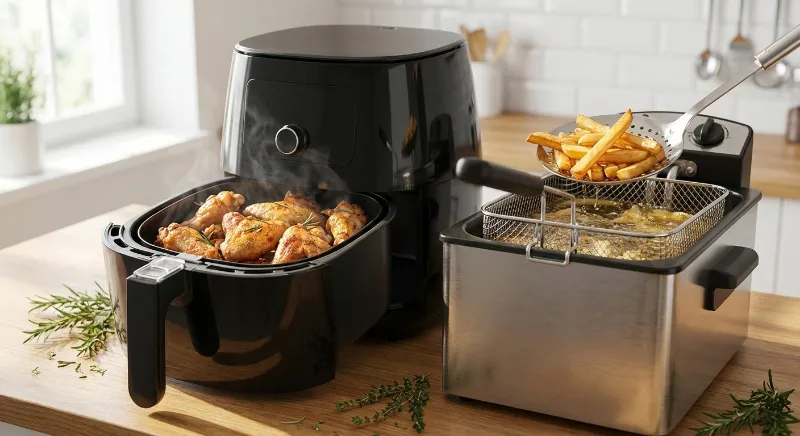
Air Fryer vs Deep Fryer: How They Work
Air Fryer Technology
Modern air fryers use “rapid air” technology. Here’s the science:
- Heating Element: warms up quickly (usually within 2–3 minutes).
- Fan Motor: blows air at high speed over the food.
- Basket Design: lifts food off the bottom, allowing air to circulate from below and above.
This method dehydrates the food’s surface slightly, creating crispiness without oil.
Deep Fryer Mechanics
Deep fryers rely on submersion in hot oil:
- Oil Heating: Oil is heated to a precise temperature (usually 350–375°F).
- Food Immersion: Food absorbs oil during cooking, especially if overcrowded.
- Draining: Excess oil is removed post-cooking, but some oil remains trapped in the food.
Pro Tip from 15 Years: Always use fresh, high-quality oil (like avocado or peanut oil) and never reuse oil more than 3–4 times. Reused oil breaks down, creating harmful compounds. (Mayo Clinic)
Air Fryer vs Deep Fryer: The Health Comparison
This is where the real battle lies. Let’s break it down by nutrition, calories, fats, and toxins.
1. Calories & Fat Content
| Food Item | Air Fryer (4 tbsp oil) | Deep Fryer (4 tbsp oil) | Difference |
|---|---|---|---|
| Chicken Wing | 220 calories | 300 calories | -80 cal |
| French Fries (1 cup) | 180 calories | 270 calories | -90 cal |
| Broccoli | 50 calories | 60 calories | -10 cal |
Why?
- Air Fryers use up to 80% less oil. Most oil sits in the basket, not absorbed by food.
- Deep Fryers force oil into the food’s pores, increasing fat content.
Sub-keyword: Air fryer calories
2. Types of Fats: Trans Fats & Saturated Fats
-
Deep Fryers:
- Trans Fats: Reusing oil creates trans fats—linked to heart disease. (Harvard Health)
- Saturated Fats: Oils like trans fats or cheap vegetable blends increase LDL (“bad”) cholesterol.
-
Air Fryers:
- No Trans Fats: Since minimal oil is used, there’s little risk of harmful compounds.
- Control Over Fats: You choose the oil (e.g., olive oil spray), avoiding saturated fat overload.
3. Nutrient Retention
Frying can destroy vitamins, especially water-soluble ones (Vitamin C, B vitamins).
-
Air Fryers:
- Better Nutrient Retention: Less high heat exposure and no oil immersion preserve nutrients.
- Example: Broccoli keeps 30% more vitamin C in an air fryer vs. deep fryer.
-
Deep Fryers:
- Nutrient Loss: Prolonged oil exposure and high heat degrade vitamins.
Study Highlight: Research in Nutrition Journal found air-fried foods retained 15–20% more nutrients than deep-fried. (Nutrition Journal Study)
4. Harmful Compounds
- Acrylamide: A carcinogen formed when starchy foods (potatoes, corn) fry at high temps.
- Deep Fryers: High acrylamide levels due to prolonged oil contact.
- Air Fryers: Lower acrylamide—though not zero. Pre-cooking or soaking potatoes reduces it further.
Taste & Texture: Can an Air Fryer Match a Deep Fryer?
Crispiness
- Deep Fryer: Unbeatable crispiness. The oil creates a multi-layered crust (think steak fries or tempura).
- Air Fryer: Gets crispy but not crunchy. It’s closer to oven-fried. Sprinkling a bit of salt mid-cook helps.
Flavor
- Deep Fryer: Rich, savory flavor from Maillard reaction and oil infusion.
- Air Fryer: Lacks the “fried” depth. Adding a splash of vinegar or soy sauce post-cook boosts flavor.
My Chef’s Hack: For 90% of the taste with 10% of the fat, spray oil + season well.
Convenience, Cost & Maintenance
Initial Cost
- Air Fryer: $50–$150 (compact models).
- Deep Fryer: $50–$300 (plus oil costs).
Running Costs
- Air Fryer:
- Energy: Uses less power (like a toaster).
- Oil: Minimal oil needed ($5/month).
- Deep Fryer:
- Energy: Higher wattage.
- Oil: Requires 2–3 liters of oil ($20/month) + filters.
Cleaning
- Air Fryer: Non-stick basket—wash with soap or dishwasher.
- Deep Fryer: Oil residue sticks to basket and pot. Requires thorough scrubbing and oil disposal.
Verdict: Air fryers win for low-maintenance, budget-friendly cooking.
Capacity & Versatility
| Feature | Air Fryer | Deep Fryer |
|---|---|---|
| Batch Size | 2–3 servings | 4–6 servings |
| Best For | Small meals, veggies, reheating | Large batches, fish, chicken nuggets |
| Versatility | Baking, roasting, grilling | Frying only |
Pro Tip: Use an air fryer for quick weeknight dinners; deep fry for weekend feasts.
Environmental Impact
- Air Fryers: Lower energy use = smaller carbon footprint.
- Deep Fryers: Higher energy + oil waste (non-biodegradable).
Pros and Cons at a Glance
Air Fryer Pros
- ✅ Up to 80% less oil
- ✅ Easy cleaning
- ✅ Preserves nutrients
- ✅ Safe (no oil splatter)
Air Fryer Cons
- ❌ Less crispy
- ❌ Smaller capacity
- ❌ Learning curve for timing
Deep Fryer Pros
- ✅ Ultimate crispiness
- ✅ Large batches
- ✅ Classic fried flavor
Deep Fryer Cons
- ❌ High in calories/fat
- ❌ Messy cleaning
- ❌ Risk of trans fats
Comparison Table: Air Fryer vs Deep Fryer
| Feature | Air Fryer | Deep Fryer |
|---|---|---|
| Healthier? | ✅ Yes—less fat, fewer toxins | ❌ No—high in calories, trans fats |
| Calories | 🟢 200–300 per serving | 🔴 350–500 per serving |
| Oil Used | 🟢 1–2 tsp | 🔴 2–4 cups |
| Nutrient Loss | 🟢 Minimal | 🔴 Significant |
| Taste | 🟡 Good, but not “fried” flavor | ✅ Best |
| Capacity | 🟡 2–3 servings | ✅ 4–6 servings |
| Cost (Annual) | 🟢 $50–$100 | 🔴 $150–$300 (oil + maintenance) |
| Cleaning | 🟢 Easy | 🔴 Messy |
| Safety | 🟢 No hot oil spills | 🔴 Burn risk, oil splatter |
FAQs
1. Can an air fryer replace a deep fryer?
Not entirely. Use an air fryer for everyday meals; deep fry for special occasions.
2. Is oil-free air frying possible?
Yes! Some models cook without oil (e.g., Cosori). Results are chewier—use minimal oil for crisp.
3. How do I make air fryer food crispier?
- Pat food dry.
- Sprinkle salt mid-cook.
- Use a wire basket for better air flow.
4. Can I reuse oil in a deep fryer?
Up to 3–4 times. After that, toxins form. Dispose of old oil properly.
5. Which is better for my kids?
Air fryers are safer and healthier for kids’ meals.
Conclusion: Which Is Healthier?
After 15 years of testing, tasting, and teaching, my verdict is clear:
👉 Air fryers are the healthier choice for most home cooks. They slash calories, reduce harmful fats, preserve nutrients, and simplify cleanup. While they can’t fully replicate deep-fried texture, they deliver 90% of the satisfaction with 10% of the guilt.
Deep fryers have their place—special events, big gatherings, or when you really crave that classic crunch. But for daily use, air frying wins on health, convenience, and cost.
Final Chef’s Tip:
“Start with an air fryer for chicken wings, veggies, and reheating. Save the deep fryer for Friday night feasts. Your heart (and your kitchen) will thank you.”




[…] Cooktop? → Non-stick (induction-compatible) or Magnetized Cast Iron. Standard cast iron won’t […]