Hey there, fellow kitchen explorer! If you’ve ever stood bewildered in front of a gleaming wall of blades, wondering, “What’s the difference between a chef’s knife and a santoku?”—you’re not alone. As a chef with 15 years of slicing, dicing, and perfecting meals in bustling professional kitchens and teaching home cooks, I’ve seen this question come up countless times. Both knives are kitchen workhorses, but they’re as different as a French bougie and a Japanese bento. Let’s dive in, and I’ll give you the real, honest scoop to help you choose the right blade for your cooking style.
Why These Two Knives Rule the Kitchen-
Before we get into specifics, know this: both a chef’s knife and a santoku are essential allies for anyone who loves cooking. Whether you’re a busy parent whipping up dinner nightly, a beginner learning your way around herbs, or a foodie experimenting with new recipes, having the right knife makes all the difference. They’re designed for different hands, different techniques, and different culinary traditions.
A Quick History Lesson: Where These Blades Come From
To truly understand what’s the difference between a chef’s knife and a santoku, we need to travel back in time.
The Chef’s Knife: A European Workhorse
The classic chef’s knife (also called a French knife) traces its roots to 18th-century France. Chefs in Parisian kitchens needed a versatile, heavy-duty blade for butchering meat, chopping vegetables, and even filleting fish. Over time, it evolved into the broader, heavier, curved-bladed tool we know today. Think of it as the “Swiss Army knife” of European kitchens—built for power and endurance.
The Santoku: Japan’s Precision Blade
Meanwhile, in Japan, the santoku (meaning “three virtues” or “three functions”) emerged in the late 19th century. It was designed as a lighter, more agile alternative to the heavier yakitori knives used for grilling. Japanese knifesmiths focused on balance, sharpness, and precision—perfect for the delicate art of sashimi, precise vegetable cuts, and minimalist preparation. Unlike Western knives, santoku blades are typically thinner and sharper, reflecting Japan’s philosophy of efficiency and respect for ingredients.
Fun Fact: The santoku’s design was influenced by the hōcho knives used in Japanese cuisine, which often feature a curved tip for intricate work.
Design & Features: The Core Differences
Now, let’s break down the physical traits that define each knife. This is where what’s the difference between a chef’s knife and a santoku becomes crystal clear.
1. Blade Shape & Length
-
Chef’s Knife:
- Blade: Broad, curved, and slightly tapered toward the tip.
- Length: Typically 8–10 inches (most common: 9 inches).
- Tip: Rounded or slightly pointed for pushing cut ingredients.
-
Santoku:
- Blade: Straight edge, thinner, and lighter. The tip is often squared off or slightly rounded.
- Length: Usually 6–7 inches (standard: 6.5–7 inches).
- Tip: Designed for precision cutting, not pushing.
Why it matters: The chef’s knife’s curved blade glides through dense foods like butternut squash or roasts effortlessly. The santoku’s straight edge and lighter weight make it ideal for slicing tomatoes or fish with surgical accuracy.
2. Weight & Balance
- Chef’s Knife: Heavier (often 8–12 oz), with the center of balance closer to the handle. Built for power cuts—think chopping bones or dense roots.
- Santoku: Lighter (5–8 oz), balanced toward the blade’s middle. Perfect for speed and control, like dicing onions or julienning carrots.
3. Edge & Sharpness
- Chef’s Knife: Wider bevel (the sloped part of the edge), requiring less frequent sharpening. Great for coarser cuts.
- Santoku: thinner bevel, sharper out-of-the-box. Needs more frequent sharpening but slices through delicate foods like butter or fish like butter (pun intended!).
Pro Tip: If you’re shopping, check the steel type! Japanese santoku knives often use auslender or VG-10 steel (learn about Japanese knife steels here), while Western chef’s knives might be high-carbon or stainless steel (see a guide to knife steels).
Usage & Functionality: When to Use Each Blade
Time to get practical! Let’s explore what each knife excels at in real kitchen scenarios.
The Chef’s Knife: Your Go-To for Heavy Lifting
This blade is the MVP for bulk preparation:
- Chopping: Butternut squash, potatoes, onions—anything dense.
- Butchering: Chicken breasts, pork roasts, or stew meat.
- Mincing: Garlic, ginger, or herbs (though a mincer might be better for tiny dice).
- Slicing: Thick-cut tomatoes or watermelon.
Why it works: The weight and curved blade act like a lever bar, reducing effort.
The Santoku: Precision & Delicacy in One Package
The santoku shines where delicacy and finesse are key:
- Slicing: Fish fillets, tomatoes, mushrooms (without squishing them!).
- Dicing: Small, uniform vegetable cubes for stir-fries.
- Shredding: Carrots or cheese (thanks to the sharp edge).
- Bon Appétit Approved: Even thin-sliced cucumbers for salads.
Real-Life Example: I once prepped 200 sushi rolls for a dinner service. My santoku sliced salmon so cleanly it felt like butter. The chef’s knife? Perfect for chopping the avocado into chunks earlier.
Hybrid Tip: If you’re short on space, an 8-inch santoku can handle many chef’s knife tasks, but the reverse isn’t always true.
Which Knife Should You Choose?
Let’s cut to the chase (pun intended!). Your ideal knife depends on your cooking habits:
Choose a Chef’s Knife If…
- You cook roasts, stews, or soups weekly.
- You need a heavy-duty blade for butchering or chopping hard veggies.
- You prefer less frequent sharpening.
- You have larger hands—the weight feels comfortable.
Choose a Santoku If…
- You’re into Japanese cuisine, sushi, or delicate fish.
- You dice vegetables daily and want perfect, uniform pieces.
- You have smaller hands and like a lighter, balanced feel.
- You sharpen your knives often (or have a sharpener handy).
Budget-Friendly Option: For home cooks, a $30–$50 santoku from brands like KAI or Wusthof offers excellent value.
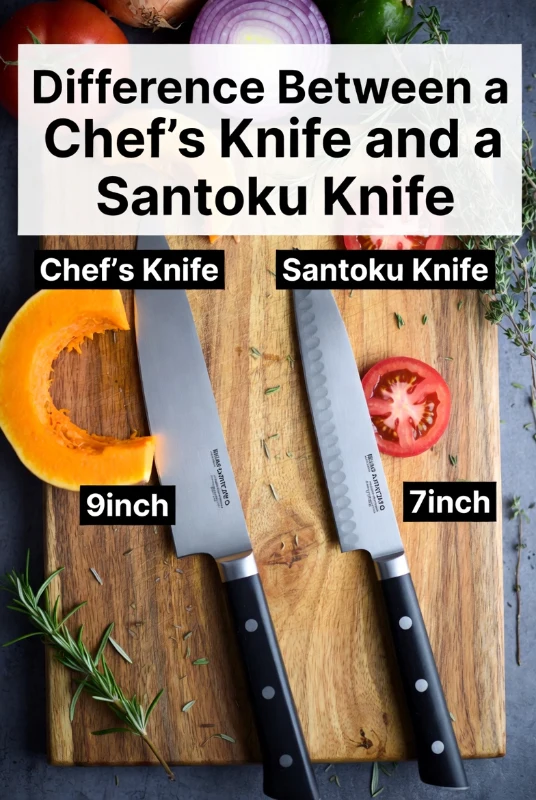
Comparison Table: Chef’s Knife vs. Santoku
Below is a clear, side-by-side breakdown to answer what’s the difference between a chef’s knife and a santoku. This table distills everything we’ve covered—design, function, and care—so you can make an informed decision for your kitchen.
| Feature | Chef’s Knife | Santoku Knife |
|---|---|---|
| Blade Shape | Curved, broad, slightly tapered toward the tip | Straight, thinner, squared or slightly rounded tip |
| Blade Length | Typically 8–10 inches (most common: 9 inches) | Usually 6–7 inches (standard: 6.5–7 inches) |
| Weight | Heavier (8–12 oz) – built for power | Lighter (5–8 oz) – designed for agility |
| Balance Point | Closer to the handle | Toward the middle of the blade |
| Edge Thickness | Wider bevel (more durable, less frequent sharpening) | Thinner bevel (sharper out-of-box, needs more frequent sharpening) |
| Sharpness | Less sharp initially; stays sharper longer | Sharper from the start; loses edge faster with heavy use |
| Best For | Chopping, butchering, heavy-duty tasks (e.g., roasts, dense veggies) | Precision slicing, delicate foods (e.g., fish, tomatoes), dicing, julienning |
| Origin | France (18th century – evolved for European kitchens) | Japan (late 19th century – designed for precision in Japanese cuisine) |
| Maintenance | Avoid hard foods (bones, shells); store in block or hook | Sharpen more often; handle delicately to preserve thin edge |
| Ideal For | Busy home cooks who prep stews, roasts, or soups regularly | Foodies who love sushi, salads, stir-fries, or delicate vegetable prep |
Care & Maintenance: Keep Both Blades Happy
A knife’s lifespan depends on how well you care for it. Here’s my pro advice:
For Both Knives
- Hand Wash Only: Never toss them in the dishwasher—steel can corrode.
- Dry Immediately: Moisture causes rust and pitting.
- Sharpen Regularly: Use a steel rod daily and a sharpener monthly.
Chef’s Knife Specifics
- Avoid Hard Foods: Shells, bones, or grapes can chip the edge.
- Store Properly: In a block or on a hook—never in a drawer!
Santoku Specifics
- Handle Delicate Foods Gently: Dropping a santoku onto concrete? You’ll lose that razor edge fast.
- Sharpen More Often: Its thin blade dulls quicker with heavy use.
Common Myths Debunked
Let’s set the record straight on a few misconceptions:
Myth 1: “A santoku is just a smaller chef’s knife.”
False! While similar in purpose, their weight distribution, blade geometry, and cultural design serve entirely different functions.
Myth 2: “Chef’s knives are always better for home cooks.”
Not true! If you mostly make salads, sushi, or stir-fries, a santoku might be more efficient.
Myth 3: “Santoku knives can’t handle heavy chopping.”
Nonsense. A well-made 7-inch santoku can chop onions and carrots fine—but avoid butchering a whole chicken.
Conclusion: What’s the Difference Between a Chef’s Knife and a Santoku?
So, after 15 years behind the stove, here’s my verdict: both knives have earned their place in my kitchen. The chef’s knife is my trusty partner for hearty meals and bulk prep, while the santoku is my precision tool for delicate tasks and Asian-inspired dishes.
Ask yourself: What do I cook most? If you’re all about roasts and stews, go for a chef’s knife. If your kitchen leans toward sushi, salads, and light fare, the santoku will become your new best friend. And if you’re like me? Collect both! They complement each other perfectly.
Remember, the right knife isn’t about brand—it’s about how it feels in your hand and serves your recipes. Happy cooking!
People Also Ask
1. Can I use a chef’s knife for sushi?
While possible, a santoku’s lighter weight and sharper edge give cleaner slices for fish, making sushi prep easier and more precise.
2. Which knife lasts longer?
Chef’s knives, thanks to thicker blades and wider bevels, resist chipping better. Santoku blades need more frequent sharpening but stay sharp longer per use.
3. Are santoku knives harder to sharpen?
Not inherently—they just require more regular maintenance due to their thinner edges. A good sharpener makes it simple.
4. What’s the best material for a santoku handle?
Japanese santoku often have wooden or bamboo handles for balance. Western versions may use ergonomic plastic or composite materials for durability.
5. Can beginners start with a santoku?
Absolutely! Its lighter weight and balanced feel make it easier for new cooks to achieve clean cuts without straining.
Pingback: My Take on Matsato Chef Knife: Honest 2026 Review + Buying Guide for Busy Families - KitchenFlavors